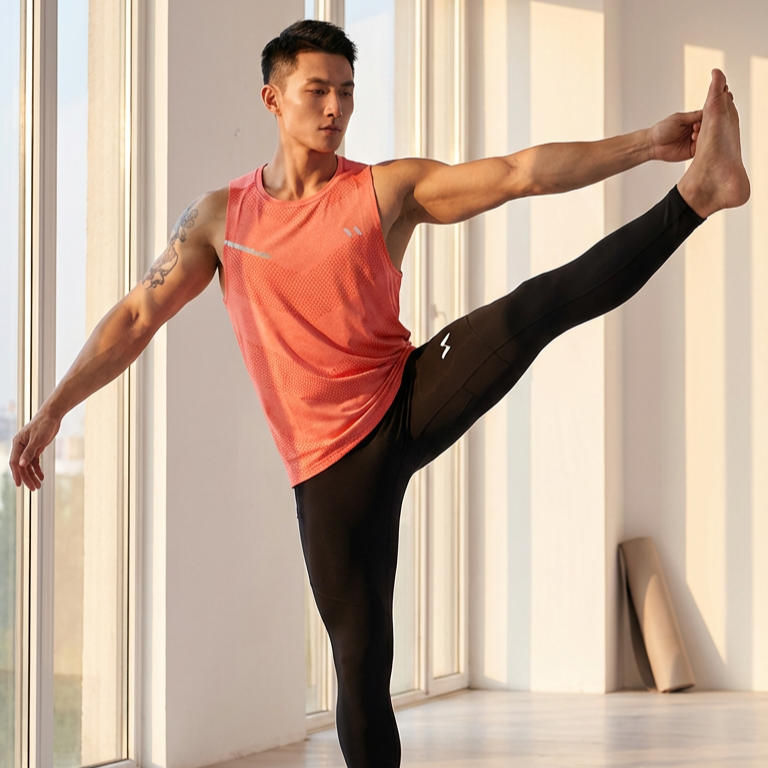
Most men do not choose yoga apparel. They inherit it.
A pair of running tights that seemed close enough. Gym shorts that already lived in the drawer. A compression shirt that worked fine for lifting. The assumption is that if something stretches, it must be suitable for the mat.
It rarely is.
Yoga stresses clothing in ways most athletic wear was never designed to handle. It asks for controlled depth rather than impact, sustained heat rather than bursts of sweat, and stillness under load rather than repetition through momentum. When apparel fails in those conditions, it becomes distracting in quiet but persistent ways.
Understanding what actually matters in men’s yoga apparel makes it easier to see why so many current options fall short.
Fabric that balances structure and breath
The first mistake is equating lightness with performance. Thin fabrics feel impressive in the hand but often lose composure under stretch or heat. They become transparent, cling unpredictably, or lose shape after a few wash cycles.
Yoga requires a balance. Fabric needs enough structure to stay opaque and stable when the body is folded, inverted, or held in place. At the same time, it must breathe and manage sweat across long sessions rather than short intervals. The goal is not to feel weightless. The goal is to feel trustworthy.
Stretch that supports rather than resists
Stretch is not binary. It is not simply present or absent. Some garments stretch easily but recover poorly. Others resist just enough to interfere with movement. Yoga demands a kind of stretch that follows the body without pulling against it and then returns to form without fatigue.
This becomes especially clear in postures that combine rotation and compression. Fabrics built for linear motion, such as running, often reveal their limits when movement becomes multi-directional and slow.
Construction that anticipates stillness
Most men’s athletic clothing is designed around speed. Stitch placement, paneling, and reinforcement are optimized for motion rather than sustained pressure. In yoga, the body is frequently asked to hold positions that compress fabric against the skin for extended periods.
When seams are placed without thought to this, irritation follows. When panels are not designed to remain composed under tension, the garment shifts. The distraction is subtle, but it accumulates.
Support that respects anatomy
This is the detail most brands avoid addressing directly. Men’s anatomy introduces unique requirements that are often ignored in yoga apparel. Without intentional internal support, comfort and modesty depend entirely on chance. This is not a failure of effort. It is a failure of design priorities.
Support should be integrated quietly, not added as an afterthought or marketing feature. It should exist to remove awareness, not draw attention.
Aesthetic restraint
Yoga is not a spectacle. Loud graphics, aggressive branding, and exaggerated silhouettes do not enhance practice. They compete with it.
Apparel that works well for yoga tends to look understated. The absence of excess becomes part of the function. Nothing pulls focus away from breath, balance, or posture.
Why so many options miss the mark
Most men’s yoga apparel is not designed from the mat outward. It is adapted from running, gym training, or lifestyle wear. The adjustments are cosmetic rather than structural. The result is clothing that performs adequately in theory but inconsistently in practice.
Until design begins with the realities of yoga rather than the conventions of athleisure, men will continue to compromise without realizing that better alternatives are possible.
The difference is not dramatic. It is deliberate.